Tyger Tyger Burning Bright
‘I never thought that the first time I would see a Bengal tiger would be her, spread across the floor. Flat, two-dimensional.’
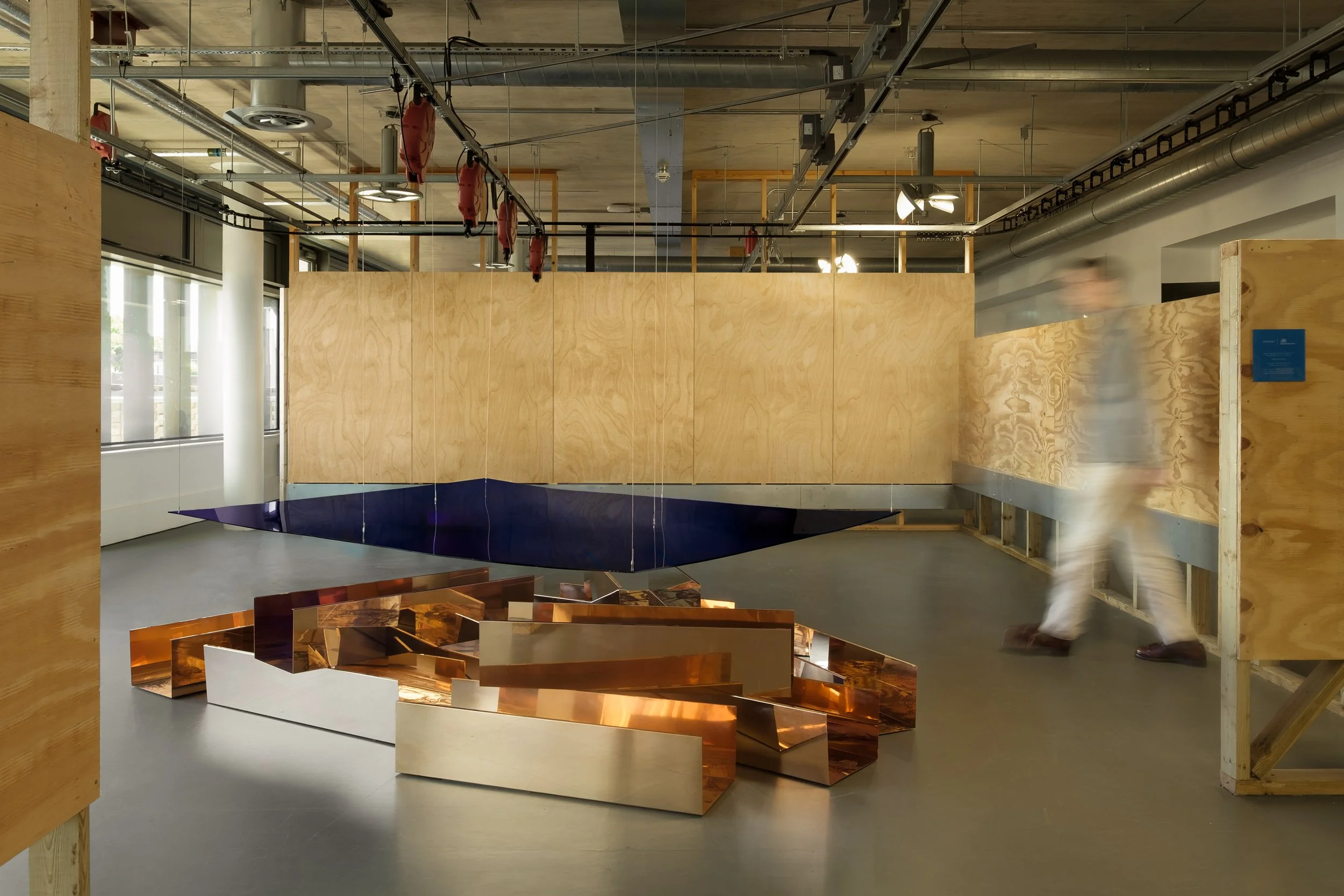
Titled eponymously after William Blake’s 1794 poem, Tyger Tyger Burning Bright is a response to an encounter with the taxidermied skin of a Bengal tigress at Powis Castle, home to one of the largest collections of South Asian artefacts acquired during the British Empire. As photography was disallowed, Rampal left the site with a series of poor images, whose degradation indexes the circulatory logic of the ethnographic museum, where artefact is irrevocably bound with artifice and the origins of the originary original remain as unlocatable as they are mythologising. For Rampal, it is no coincidence that the colonial animal thus finds itself both constructed and condemned as image, as metaphor. Could it then unbecome image? Unbecome metaphor?
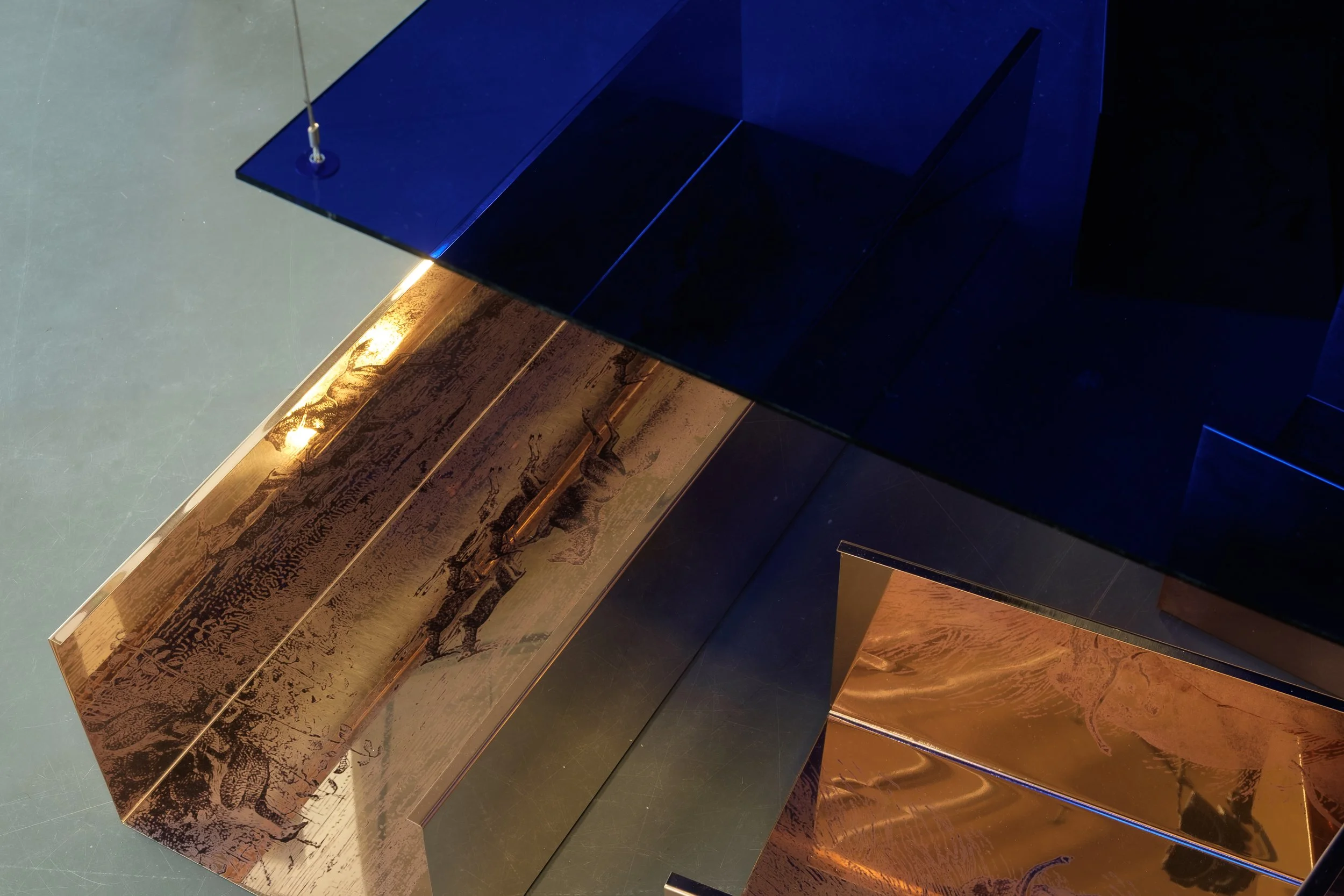
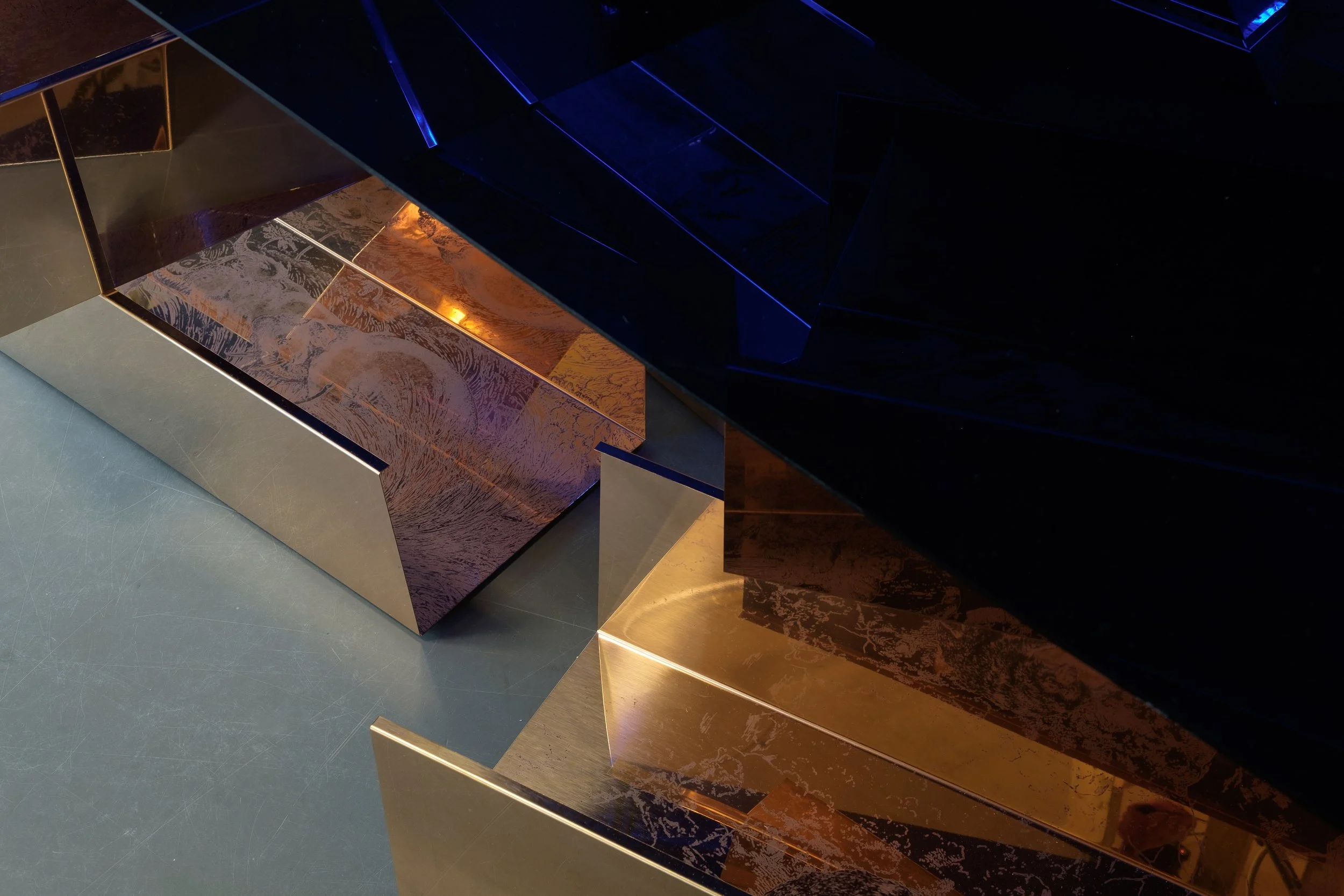
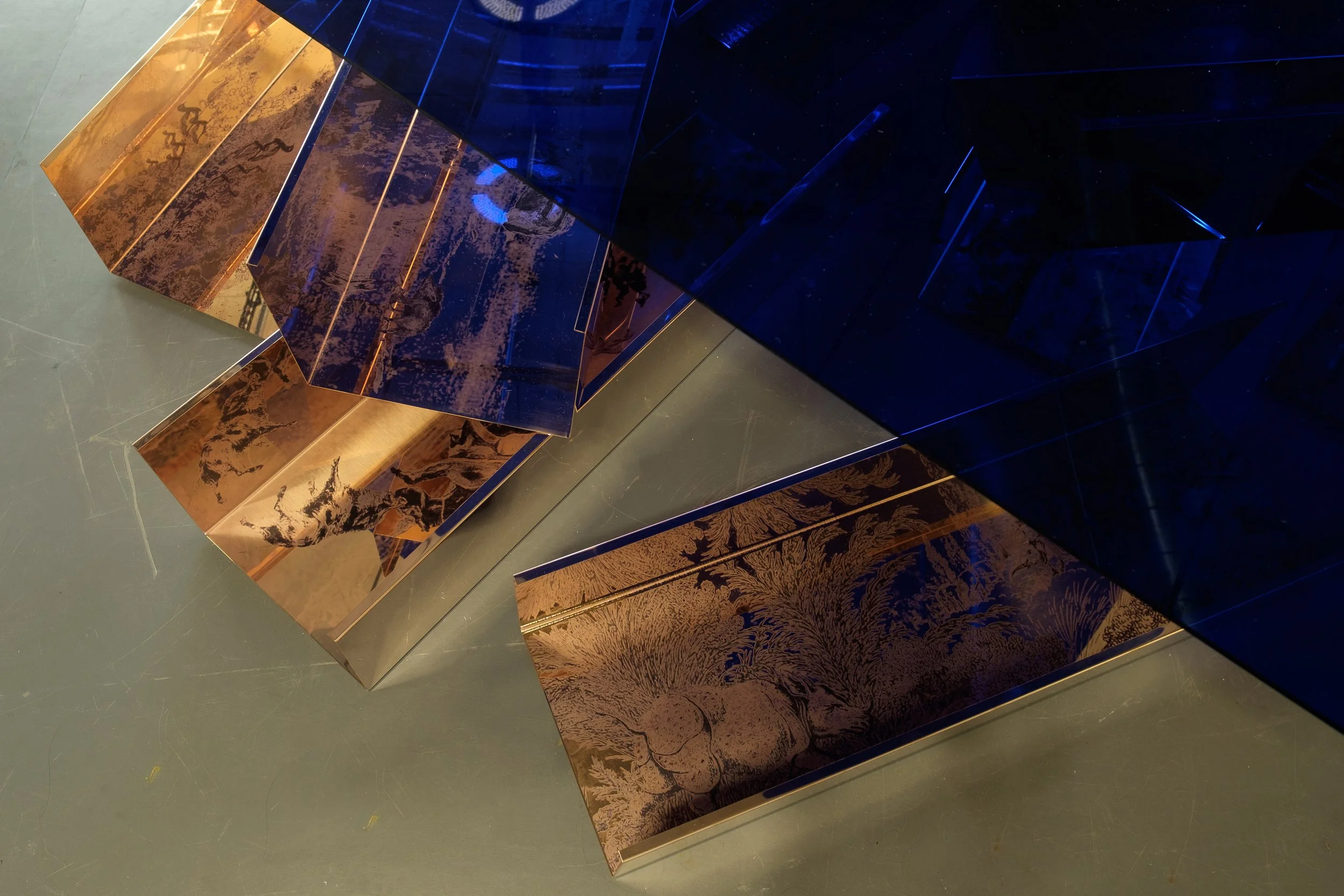
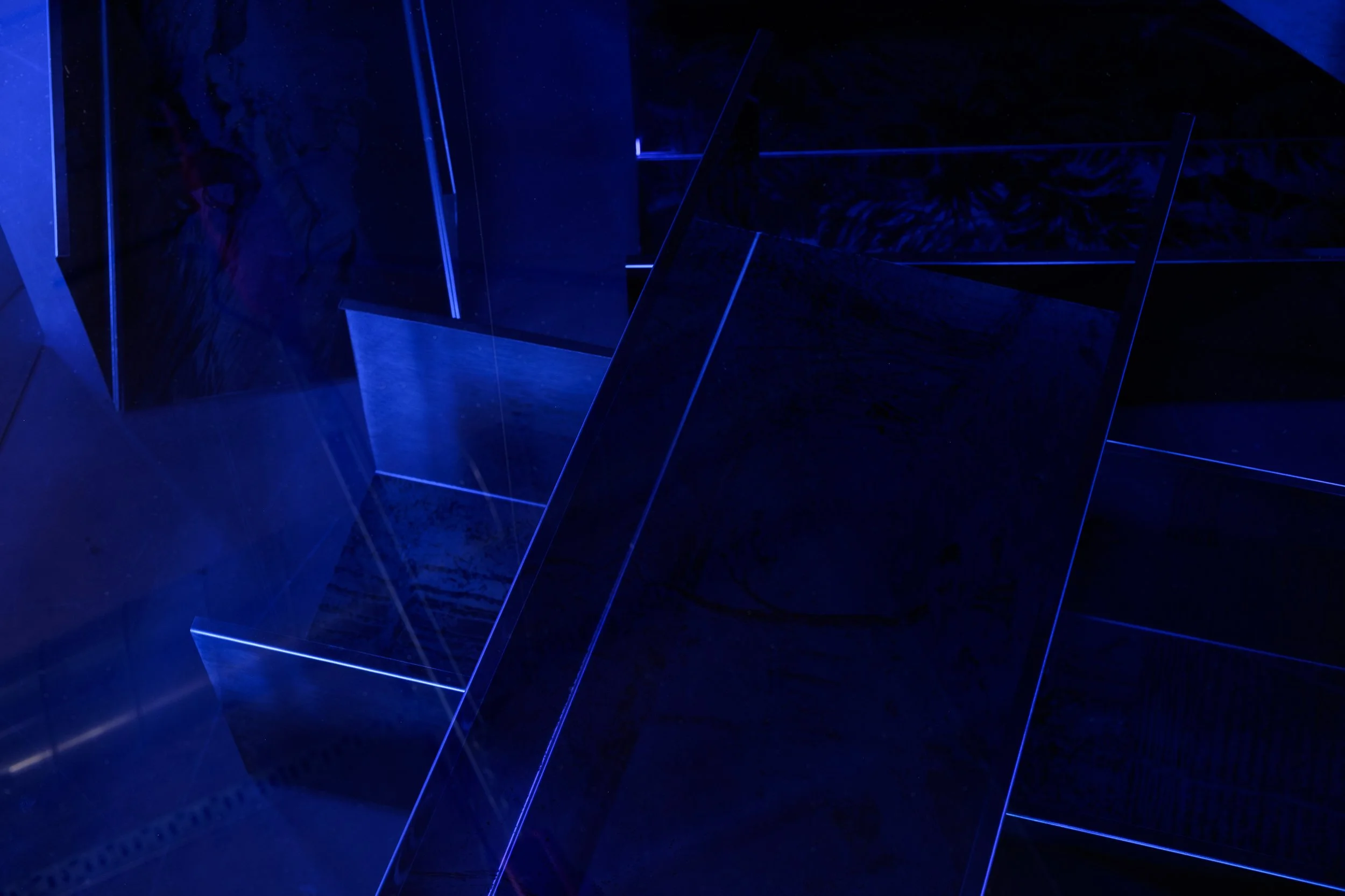
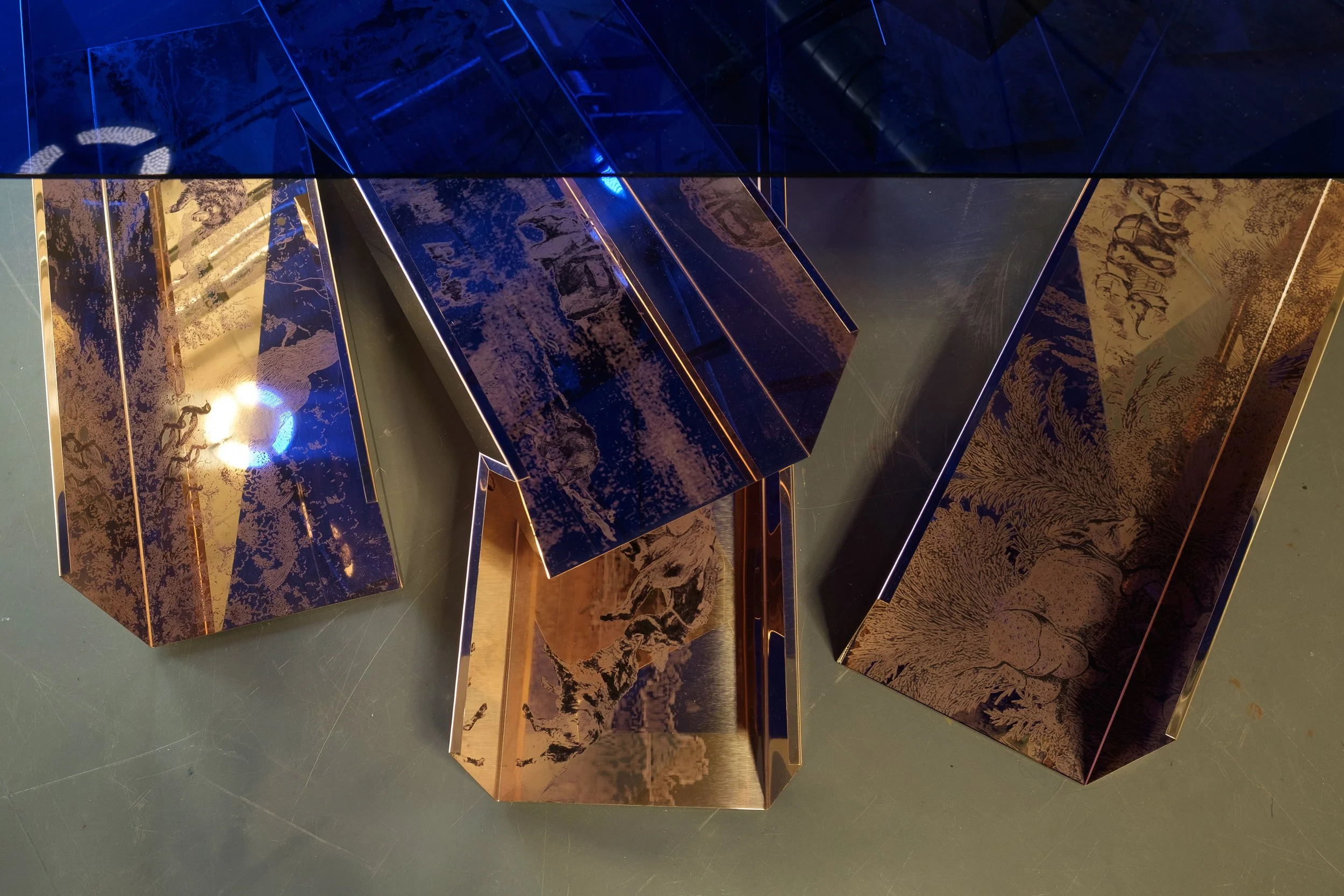
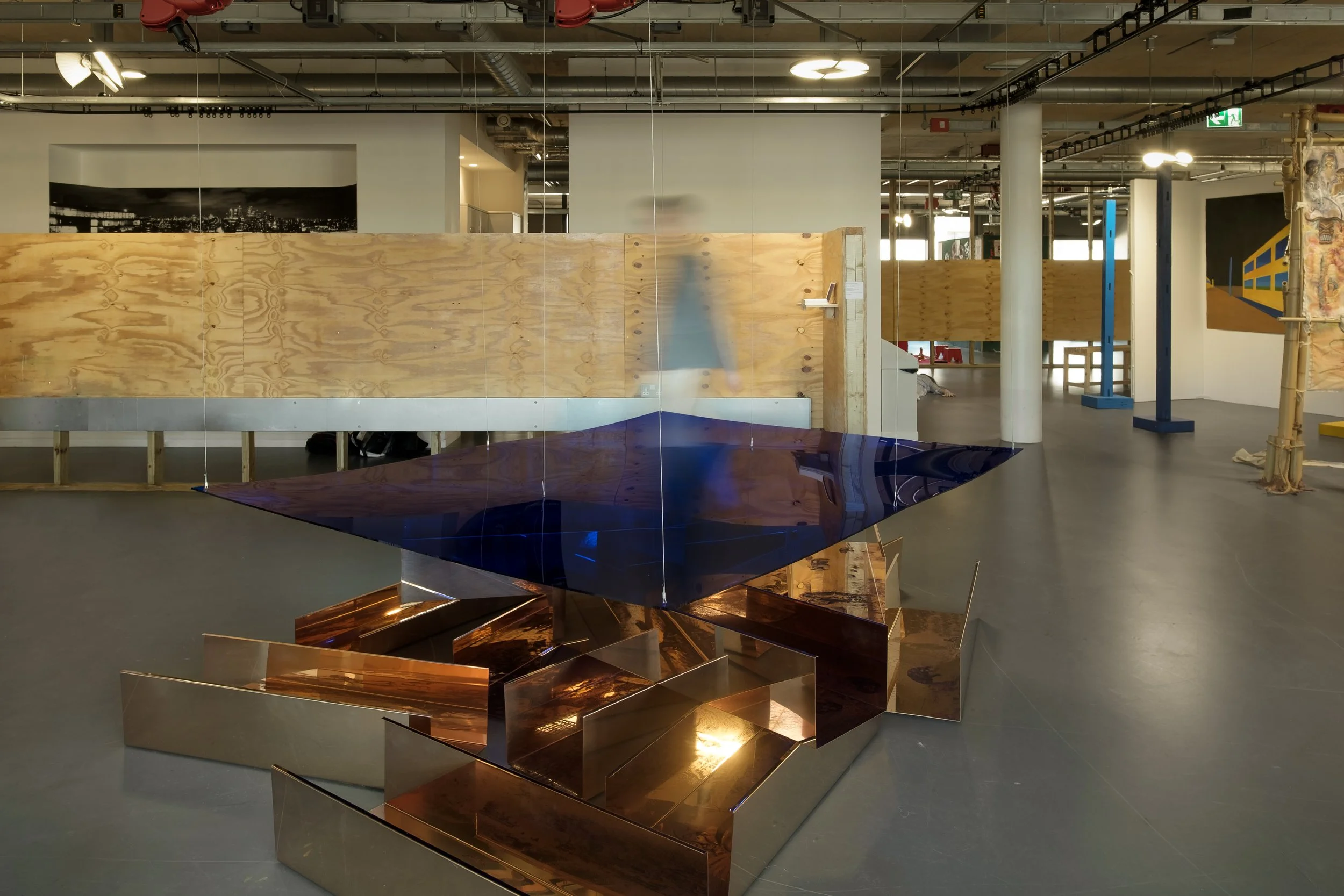
Tyger Tyger Burning Bright is an installation that operates on the horizontal axis — that of the zoomorphic, the hybrid, the syncretic, the temporal, the peripheral, as opposed to the verticality of the Great-Chain-of-Being: the anthropocentric, the hierarchical, the linear, the deterministic. The ultramarine acrylic, suspended on the horizontal plane, proposes such an invocation: to bend forward, to partially transgress bipedal to quadruped. Yet the same surface that enables access simultaneously impedes. It is difficult to see through the filter, and the long length, despite the low height, obstructs the bird's-eye view. Blake’s Tyger burns bright because, to the human eye, it is perceived as orange. Yet deer, horses and wild boar are dichromats. To the animal eye, the tiger blends with its surrounding foliage. The ultramarine filter suspended above shimmering golden image-forms attempts to enable the viewer to see as animal, but the question of becoming animal remains suspended. Colour theory falters to provide a clean cipher for metamorphosis. Perhaps the sheet is too blue, too dense, too vivid, overspilling with grief for the time-capsuled tigress, forever awaiting emancipation from collection and conquest. One is compelled to ask: is the sheet then a shrine or a shroud?
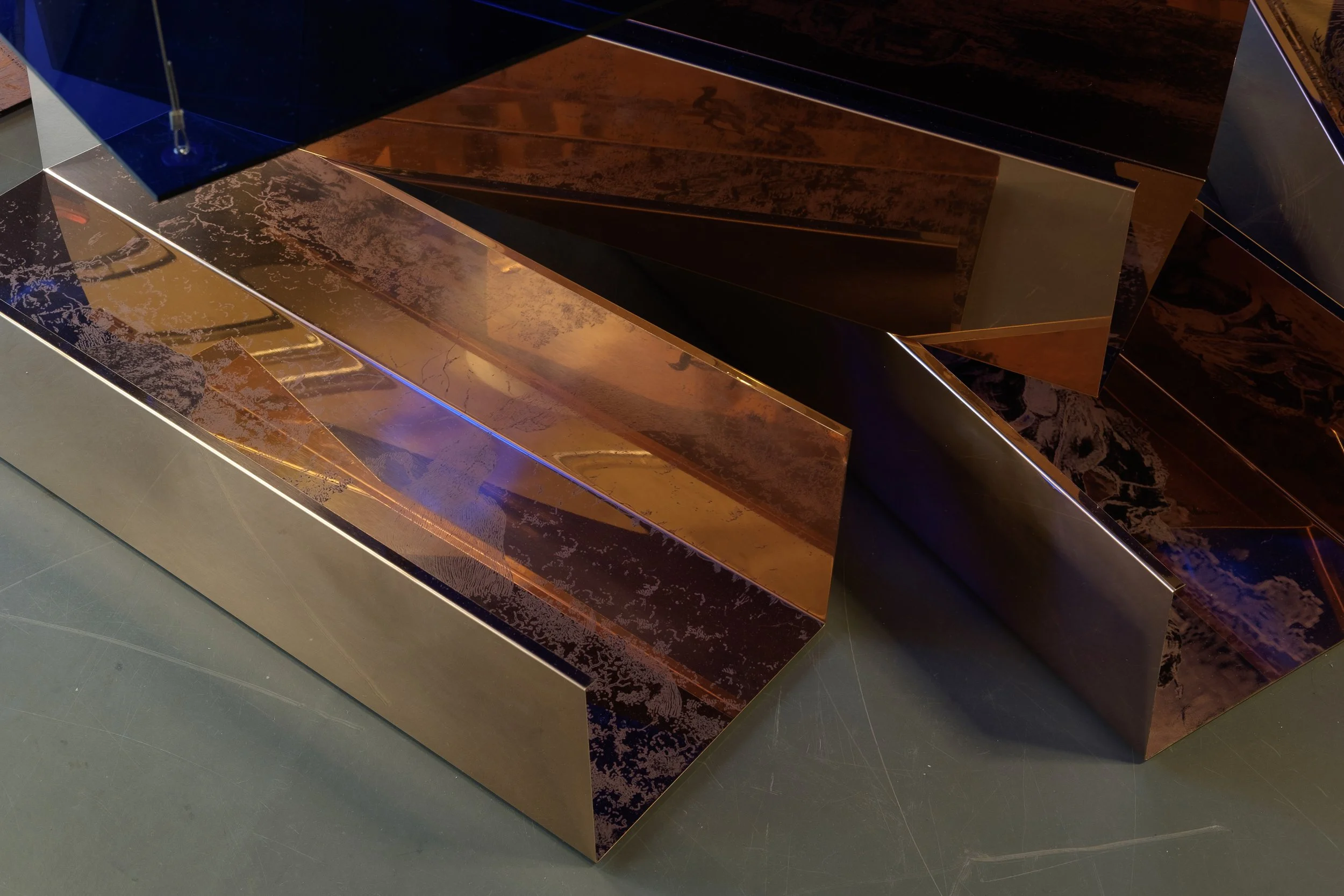
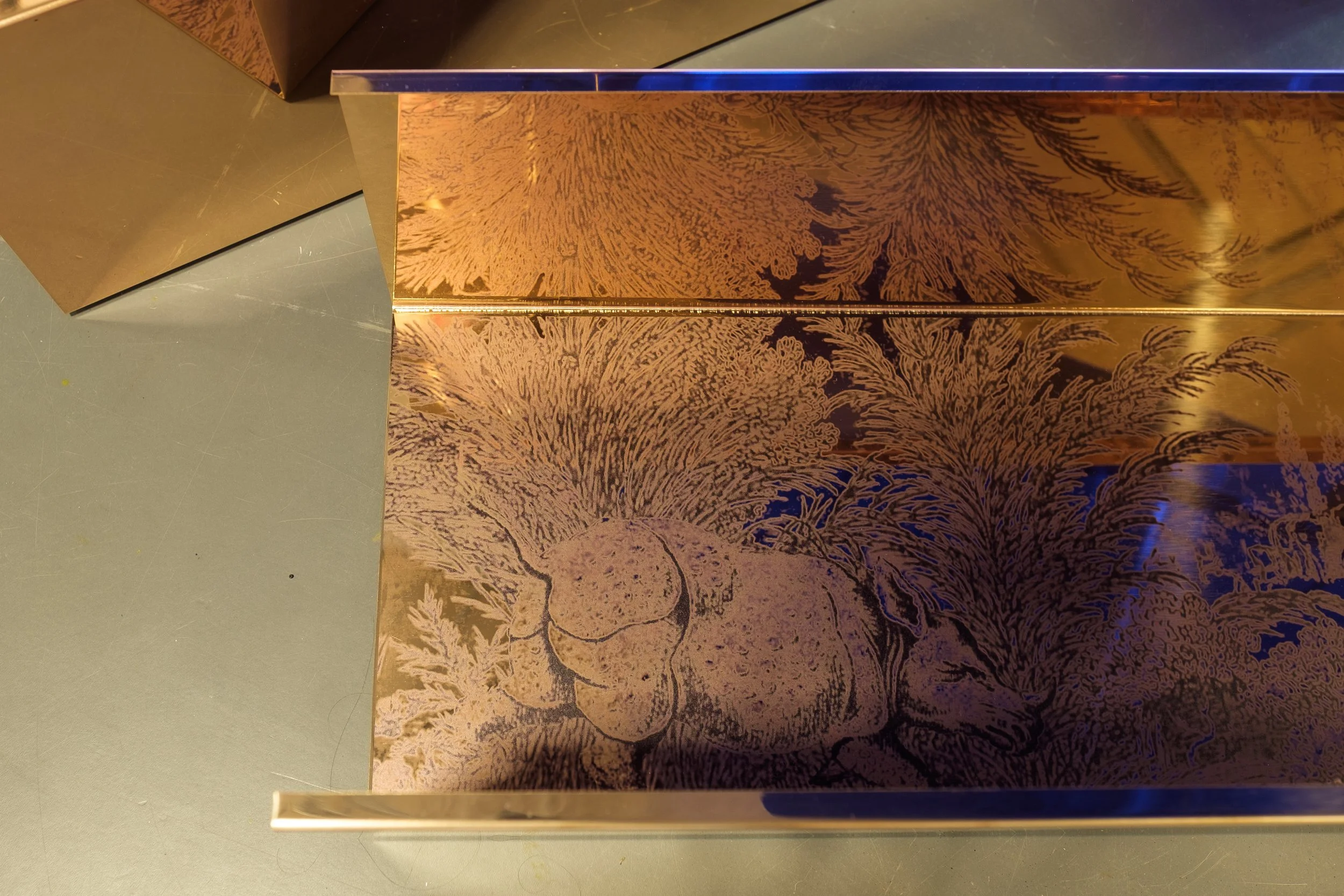
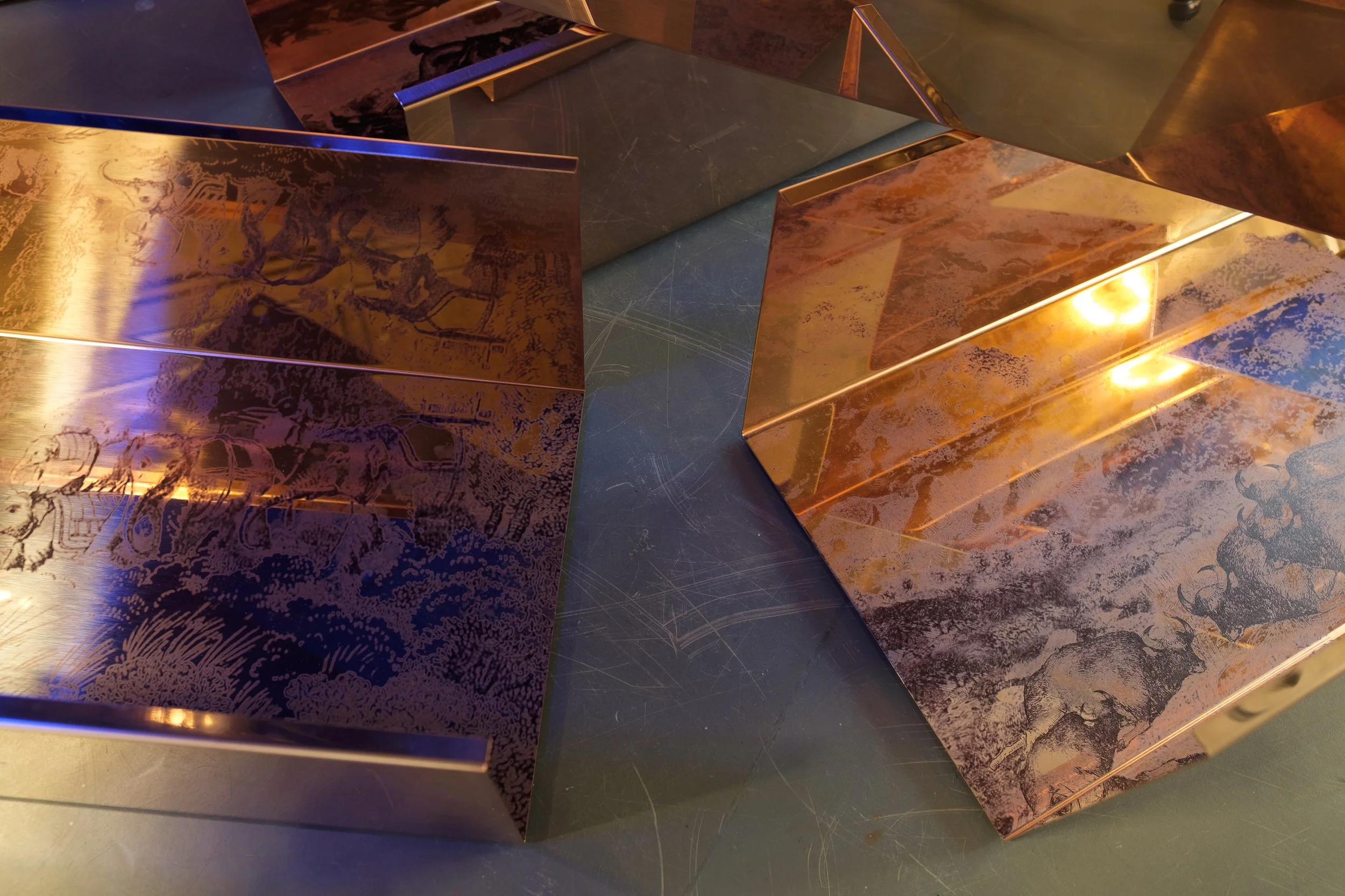
Following her visit to Powis Castle, Rampal extensively researched British hunting journals from the eighteenth to the twentieth century. Selected illustrations are digitally collaged and re-inscribed as speculative post-apocalyptic scenes on fragmented gilded forms. Through a subtractive process, three mythologies: the coloniser, the coloniser’s rendering of the native, and the tiger, have been removed. Yet vestiges remain, abandoned saddles, empty villages and opened fences, while animals considered as other to the coveted tiger continue to inhabit these landscapes. The collages appear as singular contours on a highly reflective surface, implicating both the viewer and the image itself. We are confronted not only with our own gaze but also with the doubleness of image, construct upon construct upon construct.
As always, the metal has been left unfixed, subject to time and its own material agency. It will change, and oxidise at will — a refusal against the museological vitrine.
Companion text on Tyger Tyger Burning Bright by Sotiris Gonis: Essay Link
Royal College of Art, Graduate Showcase 2026
UV print, unfixed gilding metal, acrylic
Dimensions variable
Photos: Liam Macann